
How much are YOU worth?
Looking back, I didn’t realize how lucky we were in the 1990s and early 2000s. Insurance premiums were reasonable, and a large portion of necessary healthcare was actually covered. Over time, that reality has slowly eroded—and most of us have watched it happen in real time.
Over the last 10–15 years, premiums have skyrocketed, co-pays have increased, visit limits have dropped, denials have become more common, and reimbursements—especially in rehab and therapy—have fallen dramatically. Bit by bit, we’ve allowed regulatory agencies and third-party payers to devalue healthcare itself.

Many offices are now incentivized to comply with specific metrics rather than provide meaningful, individualized care. Providers are rewarded for artificial markers of “improvement” like lower blood pressure, better cholesterol numbers, or reduced pain ratings, while patients are often told to avoid certain activities or take medications indefinitely. And all of this comes at a cost.
Even routine care carries layers of expense—pre-labs and imaging, post-labs and imaging, follow-ups to assess response, co-pays, co-insurance, prescriptions, and repeat visits. At some point, the question becomes unavoidable: what is the return on investment?

More and more providers are stepping outside of insurance networks. This has become especially common in physical therapy, where reimbursements have dropped so low that remaining in-network often means understaffed clinics, overbooked providers, shorter visits, and less time for individualized or specialized care. We’re also seeing more physicians move toward Direct Primary Care and functional or concierge-style models. Still, many patients continue to default to insurance because it feels cheaper or easier.
What’s interesting is that we don’t apply this same logic elsewhere in our lives.
Car and homeowners insurance exist for emergencies—not maintenance. We don’t expect coverage for routine repairs or upkeep. Replacing tires, fixing an HVAC system, or addressing electrical or plumbing issues are simply part of ownership, and we rarely think twice about paying for them.
On average (using North Carolina estimates), hourly rates often look like this:
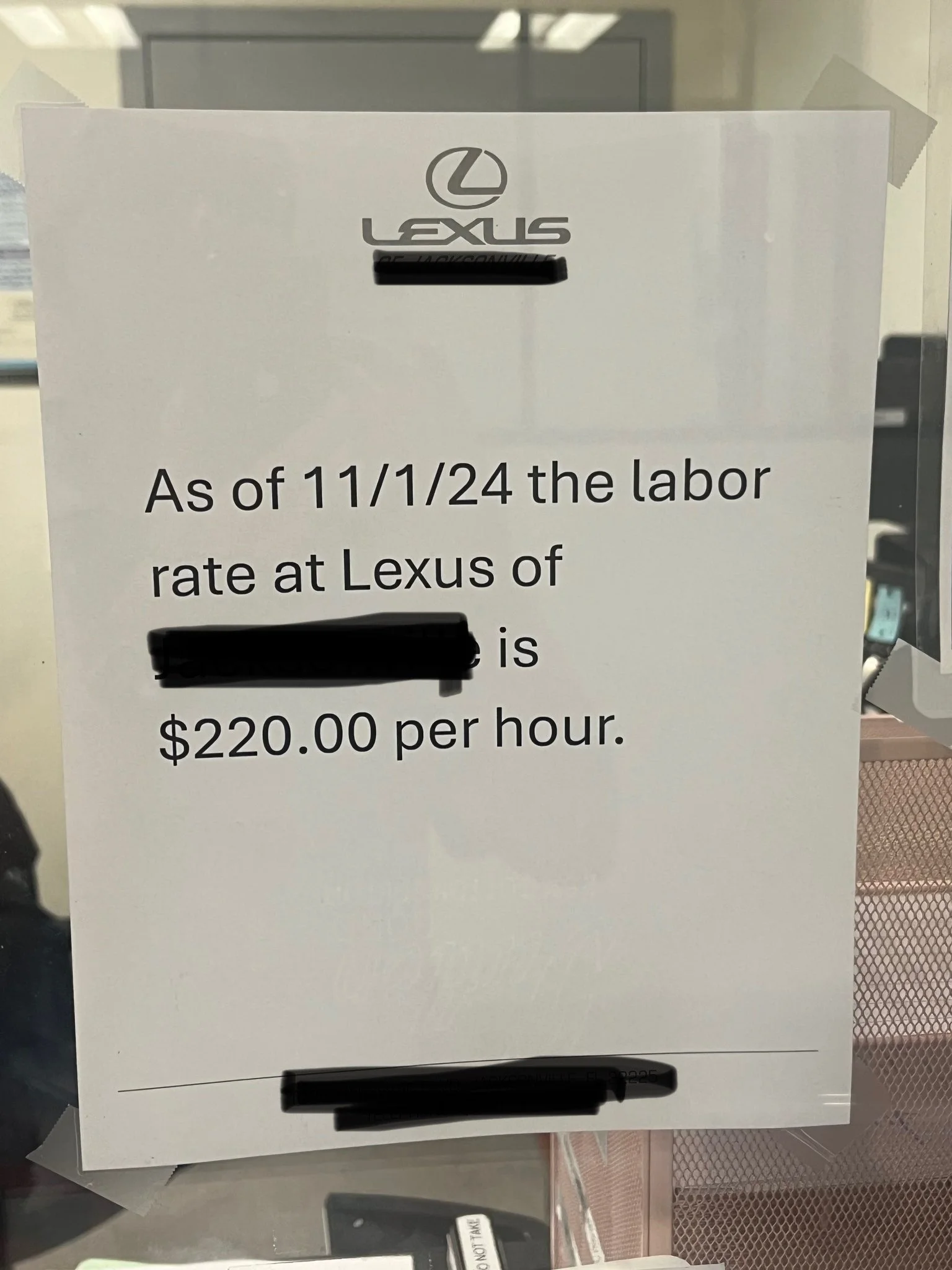
Actual post by a dealership notifying rate changes (location redacted)
Mechanic: $110–165/hr (specialized work $200+)
HVAC: $100–150/hr (specialized work $200+)
Electrician: $75–125/hr (specialized work up to $200)
Plumber: $100–150/hr (specialized work up to $200)
We accept these costs because specialized work requires training, experience, and skill. We also understand that the cheapest option is rarely the best option—especially when it comes to things we depend on every day. Our cars and homes are investments, and we want them taken care of the right way.
Yet when it comes to physical therapy and physical health—care that directly affects how you move, function, and live—we suddenly expect specialized, one-on-one expertise to cost less, take less time, and deliver more.
So why does that thinking disappear when it comes to our bodies?
Our health is not optional. Our bodies are not replaceable. Insurance can be incredibly helpful in emergencies, but more and more it does not support maintenance, prevention, or high-quality, individualized care. If you’ve never paid out of pocket for healthcare, you may not understand the difference—but there is one, and it’s often substantial.
Reimbursement-driven care devalues the time providers spend with patients, the specialized training many clinicians pursue, and the deeper work required to address root causes. Quick fixes are rewarded. Short visits are normalized. Long-term solutions are often pushed aside.

Lower visit limits, rushed appointments, and standardized approaches don’t just devalue providers—they devalue you. As a human being. As a body capable of movement, adaptation, and resilience.
It’s time to stop letting insurance define the value of healthcare. It’s time to view our bodies the same way we view our cars and homes: as necessities worth maintaining, not just repairing when something breaks.
Let’s stop searching for the CHEAPEST option.
Let’s start looking for care that respects the true VALUE of our health.